Saturday, June 15, 2019

Mathematics in Action: Algebraic, Graphical, and Trigonometric Problem Solving, CourseSmart eTextbook, 3rd Edition

Mathematics in Action: Algebraic, Graphical, and Trigonometric Problem Solving, CourseSmart eTextbook, 3rd Edition

45.00$

Test Banks & Solution Manual

  1. Test Banks for Textbooks. Save money on TEST BANKS
  2. Anticipate the type of the questions that will appear in your exam.
  3. Delivery is INSTANT. You can download the files IMMEDIATELY once payment is done.
  4. Our test banks can help! All test banks are Downloads-take them with you to study!
  5. YOU GET ALL OF THE CHAPTERS. Each Test Bank follows your textbook.
  6. Ace Your Exams with Us! We are Students Helping Students Pass.
  7. Customer Service 24/7

Mathematics in Action: Algebraic, Graphical, and Trigonometric Problem Solving, CourseSmart eTextbook, 3rd Edition Bank Test , Mathematics in Action: Algebraic, Graphical, and Trigonometric Problem Solving, CourseSmart eTextbook, 3rd Edition Textbook , Mathematics in Action: Algebraic, Graphical, and Trigonometric Problem Solving, CourseSmart eTextbook, 3rd Edition PDF , Mathematics in Action: Algebraic, Graphical, and Trigonometric Problem Solving, CourseSmart eTextbook, 3rd Edition eBook , . . Consortium for Foundation Mathematics

Category : Higher Education

Table of Contents

Preface


Chapter 1: Function Sense


Cluster 1: Modeling with Functions


Activity 1.1: Parking Problems

Objectives:

1. Distinguish between input and output.

2. Define a function.

3. Represent a function numerically and graphically.

4. Write a function using function notation.


Activity 1.2: Fill 'er Up

Objectives:

1. Determine the equation (symbolic representation) that defines a function.

2. Write the equation to define a function.

3. Determine the domain and range of a function.

4. Identify the independent and the dependent variables of a function.


Activity 1.3: Stopping Short

Objectives:

1. Use a function as a mathematical model.

2. Determine when a function is increasing, decreasing, or constant.

3. Use the vertical line test to determine if a graph represents a function.


Project Activity 1.4: Graphs Tell Stories

Objectives:

1. Describe in words what a graph tells you about a given situation.

2. Sketch a graph that best represents the situation described in words.


What Have I Learned?

How Can I Practice?


Cluster 2: Linear Functions


Activity 1.5: Walking for Fitness

Objective:

1. Determine the average rate of change.


Activity 1.6: Depreciation

Objectives:

1. Interpret slope as an average rate of change.

2. Use the formula to determine slope.

3. Discover the practical meaning of vertical and horizontal intercepts.

4. Develop the slope-intercept form of an equation of a line.

5. Use the slope-intercept formula to determine vertical and horizontal intercepts.


Activity 1.7: A New Computer

Objectives:

1. Write a linear equation in the slope-intercept form, given the initial value and the rate of change.

2. Write a linear equation given two points, one of which is the vertical intercept.

3. Use the point-slope form to write a linear equation given two points, neither of which is the vertical intercept.

4. Compare slopes of parallel lines.


Activity 1.8: Skateboard Heaven

Objectives:

1. Write an equation of a line in standard form Ax + By = C.

2. Write the slope-intercept form of a linear equation given the standard form.


Activity 1.9: College Tuition

Objectives:

1. Determine a line of best fit with a straightedge.

2. Determine the equation of a regression line using a graphing calculator.

3. Use the regression equation to interpolate and extrapolate.


What Have I Learned?

How Can I Practice?


Cluster 3: Systems of Linear Equations, Inequalities, and Absolute Value Functions


Activity 1.10: Ride for Less

Objectives:

1. Solve a system of 2 x 2 linear equations numerically and graphically.

2. Solve a system of 2 x 2 linear equations using the substitution method.

3. Solve an equation of the form ax + b = cx + d for x.


Activity 1.11: Healthy Lifestyle

Objectives:

1. Solve a 2 x 2 linear system algebraically using the substitution method and the addition method.

2. Solve equations containing parentheses.


Activity 1.12: Sam's Café

Objective:

1. Solve a 3 x 3 linear system of equations.


Activity 1.13: How Long Can You Live?

Objectives:

1. Solve linear inequalities numerically and graphically.

2. Use properties of inequalities to solve linear inequalities algebraically.

3. Solve compound inequalities algebraically and graphically.


Activity 1.14: Long Distance by Phone

Objectives:

1. Graph a piecewise linear function.

2. Write a piecewise linear function to represent a given situation.

3. Graph a function defined by y = | x - c|.


Activity 1.15: How Much Can You Tolerate?

Objectives:

1. Write a compound inequality to represent a given statement.

2. Determine the error.

3. Solve an equation involving absolute value using a number line.

4. Solve an inequality involving absolute value using a number line.

5. Solve absolute value equations and inequalities using a graphing approach.

6. Interpret absolute value as distance.

7. Graph an absolute value function.


What Have I Learned?

How Can I Practice?

Chapter 1 Summary

Chapter 1 Gateway Review


Chapter 2: The Algebra of Functions


Cluster 1: Addition, Subtraction, and Multiplication of Polynomial Functions


Activity 2.1: Spending and Earning Money

Objectives:

1. Identify a polynomial expression.

2. Identify a polynomial function.

3. Add and subtract polynomial expressions.

4. Add and subtract polynomial functions.


Project Activity 2.2: Viewing the Algebra of Functions

Objective:

1. Explore adding and subtracting functions graphically.


Activity 2.3: How Does Your Garden Grow?

Objectives:

1. Multiply two binomials using the FOIL method.

2. Multiply two polynomial functions.

3. Apply the property of exponents to multiply powers having the same base.


Activity 2.4: Stargazing

Objectives:

1. Convert scientific notation to decimal notation.

2. Convert decimal notation to scientific notation.

3. Apply the property of exponents to divide powers having the same base.

4. Apply the property of exponents a0 = 1, where a does not equal 0.

5. Apply the property of exponents a-n = 1/an where a does not equal 0 and n is any real number.


What Have I Learned?

How Can I Practice?


Cluster 2: Composition and Inverses of Functions


Activity 2.5: Inflated Balloons

Objectives:

1. Determine the composition of two functions.

2. Explore the relationship between f(g(x)) and g(f(x)).


Activity 2.6: Finding a Bargain

Objective:

1. Solve problems using the composition of functions.


Activity 2.7: The Square of a Cube

Objectives:

1. Apply the property of exponents to simplify an expression involving a power to a power.

2. Apply the property of exponents to expand the power of a product.

3. Determine the nth root of a real number.

4. Write a radical as a power having a rational exponent and write a rational exponent base to a as a radical.


Activity 2.8: Study Time

Objectives:

1. Determine the inverse of a function represented by a table of values.

2. Use the notation f-1 to represent an inverse function.

3. Use the property f(f-1(x)) = f-1(f(x)) = x to recognize inverse functions.

4. Determine the domain and range of a function and its inverse.


Activity 2.9: Temperature Conversions

Objectives:

1. Determine the equation of the inverse of a function represented by an equation.

2. Describe the relationship between the graphs of inverse functions.

3. Determine the graph of the inverse of a function represented by a graph.

4. Use the graphing calculator to produce graphs of an inverse function.


What Have I Learned?

How Can I Practice?

Chapter 2 Summary

Chapter 2 Gateway Review


Chapter 3: Exponential and Logarithmic Functions


Cluster 1: Exponential Functions


Activity 3.1: The Summer Job

Objectives:

1. Determine the growth or decay factor of an exponential function.

2. Identify the properties of the graph of an exponential function defined by y = bx, where b > 0 and b does not equal 1.

3. Graph an exponential function.


Activity 3.2: Cellular Phones

Objectives:

1. Determine the growth and decay factor for an exponential function represented by a table of values or an equation.

2. Graph exponential functions defined by y = abx where b > 0 and b does not equal 1, a does not equal 0.

3. Determine the doubling and halving time.


Activity 3.3: Population Growth

Objectives:

1. Determine annual growth or decay factor of an exponential function represented by a table of values or an equation.

2. Graph an exponential function by having equation y = a(1 + r)x, a does not equal 0.


Project Activity 3.4: Photocopying Machines

Objectives:

1. Generate data given the growth or decay rate of an exponential function.

2. Write exponential functions given the growth or decay rate.

3. Graph exponential functions from data.

4. Determine doubling and halving times from exponential functions.


Activity 3.5: Compound Interest

Objective:

1. Apply the compound interest and continuous compounding formulas to a given situation.


Activity 3.6: Continuous Growth and Decay

Objectives:

1. Discover the relationship between the equations of exponential functions defined by y = abt and the equations of continuous growth and decay exponential functions defined by y = aekt.

2. Solve problems involving continuous growth and decay models.

3. Graph base e exponential functions.


Activity 3.7: Bird Flu

Objectives:

1. Determine the regression equation of an exponential function that best fits the given data.

2. Make predictions using an exponential regression equation.

3. Determine whether a linear or exponential model best fits the data.


What Have I Learned?

How Can I Practice?


Cluster 2: Logarithmic Functions


Activity 3.8: The Diameter of Spheres

Objectives:

1. Define logarithm.

2. Write an exponential statement in logarithmic form.

3. Write a logarithmic statement in exponential form.

4. Determine log and ln values using the calculator.


Activity 3.9: Walking Speed of Pedestrians

Objectives:

1. Determine the inverse of the exponential function.

2. Identify the properties of the graph of a logarithmic function.

3. Graph the natural logarithmic function.


Activity 3.10: Walking Speed of Pedestrians, continued

Objectives:

1. Compare the average rate of change of increasing logarithmic, linear, and exponential functions.

2. Determine the regression equation of a natural logarithmic function that best fits a set of data.


Activity 3.11: The Elastic Ball

Objectives:

1. Apply the log of a product property.

2. Apply the log of a quotient property.

3. Apply the log of a power property.

4. Discover change of base formula.


Activity 3.12: Prison Growth

Objective:

1. Solve exponential equations both graphically and algebraically.


Activity 3.13: Frequency and Pitch

Objective:

1. Solve logarithmic equations both graphically and algebraically.


What Have I Learned?

How Can I Practice?

Chapter 3 Summary

Chapter 3 Gateway Review


Chapter 4: Quadratic and Higher-Order Polynomial Functions


Cluster 1: Introduction to Quadratic Functions


Activity 4.1: Baseball and the Sears Tower

Objectives:

1. Identify functions of the form f(x) = ax2 + bx + c  as quadratic functions.

2. Explore the role of c as it relates to the graph of f(x) = ax2 + bx + c.

3. Explore the role of a as it relates to the graph of f(x) = ax2 + bx + c.

4. Explore the role of b as it relates to the graph of f(x) = ax2 + bx + c.


Activity 4.2: The Shot Put

Objectives:

1. Determine the vertex or turning point of a parabola.

2. Determine the axis of symmetry of a parabola.

3. Identify the domain and range.

4. Determine the vertical intercept of a parabola.

5. Determine the horizontal intercept(s) of a parabola graphically.


Activity 4.3: Per Capita Personal Income

Objectives:

1. Solve quadratic equations numerically.

2. Solve quadratic equations graphically.

3. Solve quadratic inequalities graphically.


Activity 4.4: Sir Isaac Newton

Objectives:

1. Factor expressions by removing the greatest common factor.

2. Factor trinomials using trial and error.

3. Use the zero-product principle to solve equations.

4. Solve quadratic equations by factoring.


Activity 4.5: Motorcycle Deaths

Objective:

1. Solve quadratic equations by the quadratic formula.


Activity 4.6: Air Quality in Atlanta

Objectives:

1. Determine quadratic regression models using the graphing calculator.

2. Solve problems using quadratic regression models.


What Have I Learned?

How Can I Practice?


Cluster 2: Complex Numbers and Problem Solving Using Quadratic Functions


Activity 4.7: Complex Numbers

Objectives:

1. Identify the imaginary unit i = the square root of -1.

2. Identify a complex number.

3. Determine the value of the discriminant b2 - 4ac.

4. Determine the types of solutions to a quadratic equation.

5. Solve a quadratic equation in the complex number system.


Activity 4.8: Airfare

Objectives:

1. Build a quadratic model as a product of linear models.

2. Analyze a model contextually.


Project Activity 4.9: Chemical-Waste Holding Region

Objective:

1. Solving problems using quadratic functions.


What Have I Learned?

How Can I Practice?


Cluster 3: Curve Fitting and Higher-Order Polynomial Functions

Activity 4.10: The Power of Power Functions

Objectives:

1. Identify a direct variation function.

2. Determine the constant of variation.

3. Identify the properties of graphs of power functions defined by y = kxn, where n is a positive integer, k does not equal 0.


Activity 4.11: Hot Air Balloon

Objectives:

1. Identify equations that define polynomial functions.

2. Determine the degree of a polynomial function.

3. Determine the intercepts of the graph of a polynomial function.

4. Identify the properties of the graphs of polynomial functions.


Activity 4.12: Stolen Bases

Objectives:

1. Determine the regression equation of a polynomial function that best fits the data.

2. Distinguish between a discrete function and a continuous function.


Project Activity 4.13: Finding the Maximum Volume

Objective:

1. Problem solving using polynomial functions.


What Have I Learned?

How Can I Practice?

Chapter 4 Summary

Chapter 4 Gateway Review


Chapter 5: Rational and Radical Functions


Cluster 1: Rational Functions


Activity 5.1: Speed Limits

Objectives:

1. Determine the domain and range of a function defined by y = k/x, k is a nonzero real number.

2. Determine the vertical and horizontal asymptotes of the graph of y = k/x.

3. Sketch a graph of functions of the form y = k/x.

4. Determine the properties of graphs having equation y = k/x.


Activity 5.2: Loudness of a Sound

Objectives:

1. Graph an inverse variation function defined by an equation of the form y = k/xn , where n is any positive integer and k is a nonzero real number.

2. Describe the properties of graphs having equation y = k/xn

3. Determine the constant of proportionality (also called the constant of variation).


Activity 5.3: Percent Markup

Objectives:

1. Determine the domain of a rational function defined by an equation of the form y = k/g(x), where k is a nonzero constant and g(x) is a first-degree polynomial.

2. Identify the vertical and horizontal asymptotes of y = k/g(x).

3. Sketch a graph of rational functions defined by y = k/g(x).


Activity 5.4: Blood-Alcohol Levels

Objectives:

1. Solve an equation involving a rational expression using an algebraic approach.

2. Solve an equation involving a rational expression using a graphing approach.

3. Determine horizontal asymptotes of the graph of y = f(x)/ g(x) where f(x) and g(x) are first-degree polynomials.


Activity 5.5: Traffic Flow

Objectives:

1. Determine the least common denominator (LCD) of two or more rational expressions.

2. Solve an equation involving rational expressions using an algebraic approach.

3. Solve a formula for a specific variable.


Activity 5.6: Electrical Circuits

Objectives:

1. Multiply and divide rational expressions.

2. Add and subtract rational expressions.

3. Simplify a complex fraction.


What Have I Learned?

How Can I Practice?


Cluster 2: Radical Functions


Activity 5.7: Hang Time

Objectives:

1. Determine the domain of a radical function defined by y = the square root of g(x) where g(x) is a polynomial.

2. Graph functions having equation y = the square root of g(x) and y = negative the square root of g(x).

3. Identify the properties of the graph of y = the square root of g(x) and y = negative the square root of g(x).


Activity 5.8: Falling Objects

Objective:

1. Solve an equation involving a radical expression using a graphical and algebraic approach.


Activity 5.9: Propane Tank

Objectives:

1. Determine the domain of a function defined by an equation of the form y = the nth root of g(x) where n is a positive integer and g(x) is a polynomial.

2. Graph y = the nth root of g(x).

3. Identify the properties of graphs of y = the nth root of g(x).

4. Solve radical equations that contain radical expressions with an index other than 2.


What Have I Learned?

How Can I Practice?

Chapter 5 Summary

Chapter 5 Gateway Review


Chapter 6: Introduction to the Trigonometric Functions


Cluster 1: Introducing the Sine, Cosine, and Tangent Functions


Activity 6.1: The Leaning Tower of Pisa

Objectives:

1. Identify the sides and corresponding angles of a right triangle.

2. Determine the length of the sides of similar right triangles using proportions.

3. Determine the sine, cosine, and tangent of an angle using a right triangle.

4. Determine the sine, cosine, and tangent of an acute angle by using the graphing calculator.


Activity 6.2: A Gasoline Problem

Objectives:

1. Identify complementary angles.

2. Demonstrate that the sine and cosine of complementary angles are equal.


Activity 6.3: The Sidewalks of New York

Objectives:

1. Determine the inverse tangent of a number.

2. Determine the inverse sine and cosine of a number using the graphing calculator.

3. Identify the domain and range of the inverse sine, cosine, and tangent functions.


Activity 6.4: Solving a Murder

Objective:

1. Determine the measure of all sides and all angles of a right triangle.


Project Activity 6.5: How Stable Is That Tower?

Objectives:

1. Solve problems using right-triangle trigonometry.

2. Solve optimization problems using right-triangle trigonometry with a graphing approach.


What Have I Learned?

How Can I Practice?


Cluster 2: Why Are the Trigonometric Functions Called Circular Functions?


Activity 6.6: Learn Trigonometry or Crash!

Objectives:

1. Determine the coordinates of points on a unit circle using sine and cosine functions.

2. Sketch a graph of y = sin x and y = cos x.

3. Identify the properties of the graphs of the sine and cosine functions.


Activity 6.7: It Won't Hertz

Objectives:

1. Convert between degree and radian measure.

2. Identify the period and frequency of a function defined by y = a sin (bx) or y = a cos (bx) using the graph.


Activity 6.8: Get in Shape

Objectives:

1. Determine the amplitude of the graph of y = a sin (bx) or y = a  cos (bx).

2. Determine the period of the graph of y = a sin (bx) or y = a cos (bx) using a formula.


Activity 6.9: The Carousel

Objective:

1. Determine the displacement of y = a sin (bx + c) and y = a cos (bx + c) using a formula.


Activity 6.10: Texas Temperatures

Objectives:

1. Determine the equation of a sine function that best fits the given data.

2. Make predictions using a sine regression equation.


Project Activity 6.11: Music and Harmony

Objectives:

1. Know the relationship between wavelength and frequency.

2. Determine the sine model for a given frequency.


What Have I Learned?

How Can I Practice?

Chapter 6 Summary

Chapter 6 Gateway Review


Appendixes

Appendix A: Concept Review

Appendix B: Trigonometry

Appendix C: The TI-83/TI-84 Plus Graphing Calculator


Selected Answers

Glossary

Index

Instalant Download Mathematics in Action: Algebraic, Graphical, and Trigonometric Problem Solving, CourseSmart eTextbook, 3rd Edition by . . Consortium for Foundation Mathematics ZIP OR PDF

What is Test Bank?

The test bank is a guide for testing and exams. It contains a lot of questions with their correct answers related to an academic textbook. Test banks usually contain true/false questions, multiple choice questions, and essay questions. Authors provide those guides to help instructors and teachers create their exams and tests easily and fast. We recommend all students to download the sample attached to each test bank page and review them deeply..

What is Solutions Manual?

The solutions manual is a guide where you can find all the correct answers (odd and even) to your textbooks’ questions, cases, and problems.

Can I get a sample before buying a Test Bank or Solutions Manual?

Samples are attached to each test bank and solutions manual page at our website. We always recommend students and instructors to download the samples before placing orders. At MANUALS1 we offer a complete sample chapter for each product.

Can I download my files immediately after completing the order?

Yes. Our system will grant you an access to download your files immediately after completing the order.

How will I download my product?

You will receive an email from testbanky that contains the download link.

I am not able to download my test bank or solution manual

If you could not download your product for any reason, contact us and we will solve the issue immediately.

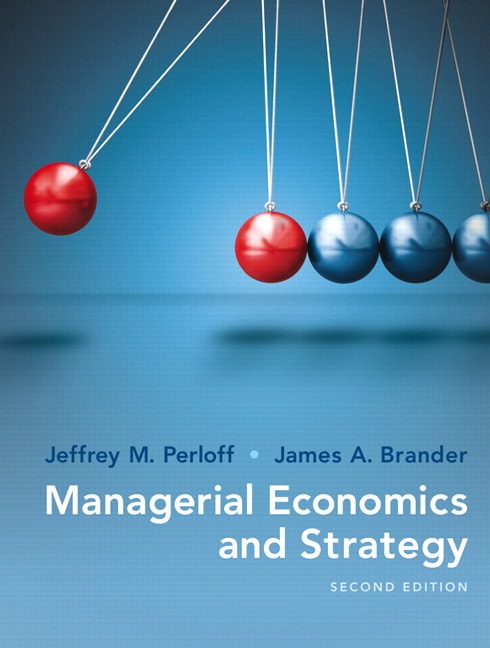
Managerial Economics and Strategy, 2nd Edition

Managerial Economics and Strategy, 2nd Edition

45.00$

Test Banks & Solution Manual

  1. Test Banks for Textbooks. Save money on TEST BANKS
  2. Anticipate the type of the questions that will appear in your exam.
  3. Delivery is INSTANT. You can download the files IMMEDIATELY once payment is done.
  4. Our test banks can help! All test banks are Downloads-take them with you to study!
  5. YOU GET ALL OF THE CHAPTERS. Each Test Bank follows your textbook.
  6. Ace Your Exams with Us! We are Students Helping Students Pass.
  7. Customer Service 24/7

Managerial Economics and Strategy, 2nd Edition Bank Test , Managerial Economics and Strategy, 2nd Edition Textbook , Managerial Economics and Strategy, 2nd Edition PDF , Managerial Economics and Strategy, 2nd Edition eBook , Jeffrey M. Perloff, University of California-Berkeley James A. Brander, University of British Columbia

Category : Higher Education

Table of Contents

1. Introduction

2. Supply and Demand

3. Empirical Methods for Demand Analysis

4. Consumer Choice

5. Production

6. Costs

7. Firm Organization and Market Structure

8. Competitive Firms and Markets

9. Monopoly

10. Pricing with Market Power

11. Oligopoly and Monopolistic Competition

12. Game Theory and Business Strategy

13. Strategies over Time

14. Managerial Decision Making Under Uncertainty

15. Asymmetric Information

16. Government and Business

17. Global Business


Answers to Selected Questions

Definitions

References

Sources for Managerial Problems, Mini-Cases, and Managerial Implications

Index

Credits

Instalant Download Managerial Economics and Strategy, 2nd Edition by Jeffrey M. Perloff, University of California-Berkeley James A. Brander, University of British Columbia ZIP OR PDF

What is Test Bank?

The test bank is a guide for testing and exams. It contains a lot of questions with their correct answers related to an academic textbook. Test banks usually contain true/false questions, multiple choice questions, and essay questions. Authors provide those guides to help instructors and teachers create their exams and tests easily and fast. We recommend all students to download the sample attached to each test bank page and review them deeply..

What is Solutions Manual?

The solutions manual is a guide where you can find all the correct answers (odd and even) to your textbooks’ questions, cases, and problems.

Can I get a sample before buying a Test Bank or Solutions Manual?

Samples are attached to each test bank and solutions manual page at our website. We always recommend students and instructors to download the samples before placing orders. At MANUALS1 we offer a complete sample chapter for each product.

Can I download my files immediately after completing the order?

Yes. Our system will grant you an access to download your files immediately after completing the order.

How will I download my product?

You will receive an email from testbanky that contains the download link.

I am not able to download my test bank or solution manual

If you could not download your product for any reason, contact us and we will solve the issue immediately.

Friday, June 14, 2019

Children's Literature, Briefly, 2nd Edition

Children's Literature, Briefly, 2nd Edition

45.00$

Test Banks & Solution Manual

  1. Test Banks for Textbooks. Save money on TEST BANKS
  2. Anticipate the type of the questions that will appear in your exam.
  3. Delivery is INSTANT. You can download the files IMMEDIATELY once payment is done.
  4. Our test banks can help! All test banks are Downloads-take them with you to study!
  5. YOU GET ALL OF THE CHAPTERS. Each Test Bank follows your textbook.
  6. Ace Your Exams with Us! We are Students Helping Students Pass.
  7. Customer Service 24/7

Children's Literature, Briefly, 2nd Edition Bank Test , Children's Literature, Briefly, 2nd Edition Textbook , Children's Literature, Briefly, 2nd Edition PDF , Children's Literature, Briefly, 2nd Edition eBook , Michael O. Tunnell, Washington State University James S. Jacobs, Brigham Young University

Category : Higher Education

Table of Contents

I. THE BOOK.

 1. Why Read?

 2. What Is a Good Book?

 3. What Is a Good Book? The Words.

 4. What Is a Good Book? The Pictures.

 5. Children's Books: History and Trends.

II. THE CONTENT.

 6. Categories of Children's Literature.

 7. Traditional Fantasy.

 8. Modern Fantasy.

 9. Contemporary Realistic Fiction.

10. Historical Fiction.

11. Biography.

12. Informational Books.

13. Picture Books.

14. Poetry.

15. Multicultural and International Books.

16. Controversial Books.

III. THE CLASSROOM.

17. The Teacher as Reader.

18. Motivating Students to Read.

19. Building a Classroom Library.

20. Teaching Reading with Children's Literature.

21. Evaluating Children's Reading.

22. Teaching the Curriculum with Children's Literature.

Appendix A: Book Selection Aids.

Appendix B: Magazines for Children.

Appendix C: Publishing Children's Books.

Appendix D: Audiovisual Media and Children's Books.

Appendix E: Author and Illustrator Visits.

Appendix F: Children's Book Awards.

Appendix G: Publishers' Addresses.

Instalant Download Children's Literature, Briefly, 2nd Edition by Michael O. Tunnell, Washington State University James S. Jacobs, Brigham Young University ZIP OR PDF

What is Test Bank?

The test bank is a guide for testing and exams. It contains a lot of questions with their correct answers related to an academic textbook. Test banks usually contain true/false questions, multiple choice questions, and essay questions. Authors provide those guides to help instructors and teachers create their exams and tests easily and fast. We recommend all students to download the sample attached to each test bank page and review them deeply..

What is Solutions Manual?

The solutions manual is a guide where you can find all the correct answers (odd and even) to your textbooks’ questions, cases, and problems.

Can I get a sample before buying a Test Bank or Solutions Manual?

Samples are attached to each test bank and solutions manual page at our website. We always recommend students and instructors to download the samples before placing orders. At MANUALS1 we offer a complete sample chapter for each product.

Can I download my files immediately after completing the order?

Yes. Our system will grant you an access to download your files immediately after completing the order.

How will I download my product?

You will receive an email from testbanky that contains the download link.

I am not able to download my test bank or solution manual

If you could not download your product for any reason, contact us and we will solve the issue immediately.

Thursday, June 13, 2019

Understanding Psychology (Subscription), 11th Edition

Understanding Psychology (Subscription), 11th Edition

45.00$

Test Banks & Solution Manual

  1. Test Banks for Textbooks. Save money on TEST BANKS
  2. Anticipate the type of the questions that will appear in your exam.
  3. Delivery is INSTANT. You can download the files IMMEDIATELY once payment is done.
  4. Our test banks can help! All test banks are Downloads-take them with you to study!
  5. YOU GET ALL OF THE CHAPTERS. Each Test Bank follows your textbook.
  6. Ace Your Exams with Us! We are Students Helping Students Pass.
  7. Customer Service 24/7

Understanding Psychology (Subscription), 11th Edition Bank Test , Understanding Psychology (Subscription), 11th Edition Textbook , Understanding Psychology (Subscription), 11th Edition PDF , Understanding Psychology (Subscription), 11th Edition eBook , Charles G. Morris, Professor Emeritus, University of Michigan

Category : Higher Education

Table of Contents

1. The Science of Psychology
2. The Biological Basis of Behavior
3. Sensation and Perception
4. States of Consciousness
5. Learning
6. Memory
7. Cognition and Mental Abilities
8. Motivation and Emotion
9. Life-Span Development
10. Personality
11. Stress and Health Psychology
12. Psychological Disorders
13. Therapies
14. Social Psychology
Appendix A: Measurement and Statistical Methods
Appendix B: Psychology Applied to Work

Instalant Download Understanding Psychology (Subscription), 11th Edition by Charles G. Morris, Professor Emeritus, University of Michigan ZIP OR PDF

What is Test Bank?

The test bank is a guide for testing and exams. It contains a lot of questions with their correct answers related to an academic textbook. Test banks usually contain true/false questions, multiple choice questions, and essay questions. Authors provide those guides to help instructors and teachers create their exams and tests easily and fast. We recommend all students to download the sample attached to each test bank page and review them deeply..

What is Solutions Manual?

The solutions manual is a guide where you can find all the correct answers (odd and even) to your textbooks’ questions, cases, and problems.

Can I get a sample before buying a Test Bank or Solutions Manual?

Samples are attached to each test bank and solutions manual page at our website. We always recommend students and instructors to download the samples before placing orders. At MANUALS1 we offer a complete sample chapter for each product.

Can I download my files immediately after completing the order?

Yes. Our system will grant you an access to download your files immediately after completing the order.

How will I download my product?

You will receive an email from testbanky that contains the download link.

I am not able to download my test bank or solution manual

If you could not download your product for any reason, contact us and we will solve the issue immediately.
Wednesday, June 12, 2019

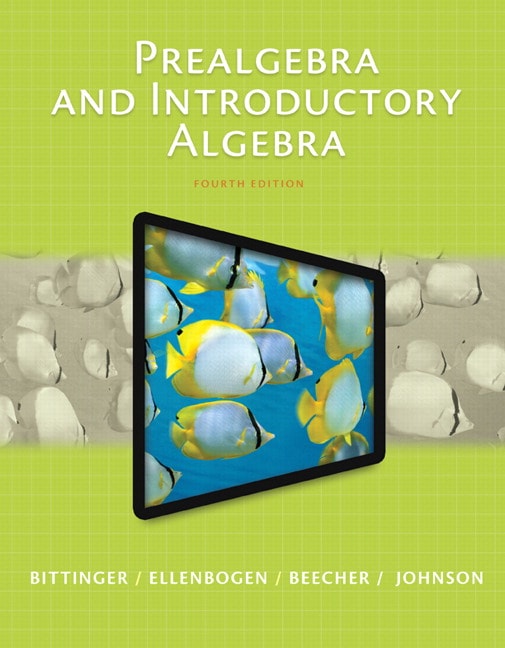
Prealgebra and Introductory Algebra, 4th Edition

Prealgebra and Introductory Algebra, 4th Edition

45.00$

Test Banks & Solution Manual

  1. Test Banks for Textbooks. Save money on TEST BANKS
  2. Anticipate the type of the questions that will appear in your exam.
  3. Delivery is INSTANT. You can download the files IMMEDIATELY once payment is done.
  4. Our test banks can help! All test banks are Downloads-take them with you to study!
  5. YOU GET ALL OF THE CHAPTERS. Each Test Bank follows your textbook.
  6. Ace Your Exams with Us! We are Students Helping Students Pass.
  7. Customer Service 24/7

Prealgebra and Introductory Algebra, 4th Edition Bank Test , Prealgebra and Introductory Algebra, 4th Edition Textbook , Prealgebra and Introductory Algebra, 4th Edition PDF , Prealgebra and Introductory Algebra, 4th Edition eBook , Marvin L. Bittinger, Indiana University Purdue University Indianapolis David J. Ellenbogen, Community College of Vermont Judith A. Beecher, Indiana University Purdue University Indianapolis Barbara L. Johnson, Ivy Tech Community College of Indiana

Category : Higher Education

Table of Contents

1. Whole Numbers

1.1 Standard Notation

1.2 Addition

1.3 Subtraction

1.4 Multiplication

1.5 Division

1.6 Rounding and Estimating; Order

1.7 Solving Equations

1.8 Applications and Problem Solving

1.9 Exponential Notation and Order of Operations


2. Introduction to Integers and Algebraic Expressions

2.1 Integers and the Number Line

2.2 Addition of Integers

2.3 Subtraction of Integers

2.4 Multiplication of Integers

2.5 Division of Integers and Order of Operations

2.6 Introduction to Algebra and Expressions

2.7 Like Terms and Perimeter

2.8 Solving Equations


3. Fraction Notation: Multiplication and Division

3.1 Multiples and Divisibility

3.2 Factorizations

3.3 Fractions and Fraction Notation

3.4 Multiplication and Applications

3.5 Simplifying

3.6 Multiplying, Simplifying, and More with Area

3.7 Reciprocals and Division

3.8 Solving Equations: The Multiplication Principle


4. Fraction Notation: Addition, Subtraction, and Mixed Numerals

4.1 Least Common Multiples

4.2 Addition, Order, and Applications

4.3 Subtraction, Equations, and Applications

4.4 Solving Equations: Using the Principles Together

4.5 Mixed Numerals

4.6 Addition and Subtraction Using Mixed Numerals; Applications

4.7 Multiplication and Division of Mixed Numerals; Applications

4.8 Order of Operations and Complex Fractions


5. Decimal Notation

5.1 Decimal Notation, Order, and Rounding

5.2 Addition and Subtraction of Decimals

5.3 Multiplication of Decimals

5.4 Division of Decimals

5.5 Using Fraction Notation with Decimal Notation

5.6 Estimating

5.7 Solving Equations

5.8 Applications and Problem Solving


6. Percent Notation

6.1 Ratio and Proportion

6.2 Percent Notation

6.3 Percent Notation and Fraction Notation

6.4 Solving Percent Problems Using Percent Equations

6.5 Solving Percent Problems Using Proportions

6.6 Applications of Percent

6.7 Sales Tax, Commission, and Discount

6.8 Simple Interest and Compound Interest; Credit Cards


7. Data, Graphs, and Statistics

7.1 Averages, Medians, and Modes

7.2 Interpreting Data from Tables and Graphs

7.3 Interpreting and Drawing Bar Graphs and Line Graphs

7.4 Interpreting and Drawing Circle Graphs


8. Geometry

8.1 Basic Geometric Figures

8.2 Perimeter

8.3 Area

8.4 Circles

8.5 Volume and Surface Area

8.6 Relationships Between Angle Measures

8.7 Congruent Triangles and Properties of Parallelograms

8.8 Similar Triangles


9. Introduction to Real Numbers and Algebraic Expressions

9.1 Introduction to Algebra

9.2 The Real Numbers

9.3 Addition of Real Numbers

9.4 Subtraction of Real Numbers

9.5 Multiplication of Real Numbers

9.6 Division of Real Numbers

9.7 Properties of Real Numbers

9.8 Simplifying Expressions; Order of Operations


10. Solving Equations and Inequalities

10.1 Solving Equations: The Addition Principle

10.2 Solving Equations: The Multiplication Principle

10.3 Using the Principles Together

10.4 Formulas

10.5 Applications of Percent

10.6 Applications and Problem Solving

10.7 Solving Inequalities

10.8 Applications and Problem Solving with Inequalities


11. Graphs of Linear Equations

11.1 Graphs and Applications of Linear Equations

11.2 More with Graphing and Intercepts

11.3 Slope and Applications

11.4 Equations of Lines

11.5 Graphing Using the Slope and the y-Intercept

11.6 Parallel Lines and Perpendicular Lines

11.7 Graphing Inequalities in Two Variables


12. Polynomials: Operations

12.1 Integers as Exponents

12.2 Exponents and Scientific Notation

12.3 Introduction to Polynomials

12.4 Addition and Subtraction of Polynomials

12.5 Multiplication of Polynomials

12.6 Special Products

12.7 Operations with Polynomials in Several Variables

12.8 Division of Polynomials


13. Polynomials: Factoring

13.1 Introduction to Factoring

13.2 Factoring Trinomials of the Type x2 + bx + c

13.3 Factoring ax2 + bx + c, a ≠ 1: The FOIL Method

13.4 Factoring ax2 + bx + c, a ≠ 1: The ac-Method

13.5 Factoring Trinomial Squares and Differences of Squares

13.6 Factoring: A General Strategy

13.7 Solving Quadratic Equations by Factoring

13.8 Applications of Quadratic Equations


14. Rational Expressions and Equations

14.1 Multiplying and Simplifying Rational Expressions

14.2 Division and Reciprocals

14.3 Least Common Multiples and Denominators

14.4 Adding Rational Expressions

14.5 Subtracting Rational Expressions

14.6 Complex Rational Expressions

14.7 Solving Rational Equations

14.8 Applications Using Rational Equations and Proportions

14.9 Direct Variation and Inverse Variation


15. Systems of Equations

15.1 Systems of Equations in Two Variables

15.2 The Substitution Method

15.3 The Elimination Method

15.4 Applications and Problem Solving

15.5 Applications with Motion


16. Radical Expressions and Equations

16.1 Introduction to Radical Expressions

16.2 Multiplying and Simplifying with Radical Expressions

16.3 Quotients Involving Radical Expressions

16.4 Addition, Subtraction, and More Multiplication

16.5 Radical Equations

16.6 Applications with Right Triangles


17. Quadratic Equations

17.1 Introduction to Quadratic Equations

17.2 Solving Quadratic Equations by Completing the Square

17.3 The Quadratic Formula

17.4 Formulas

17.5 Applications and Problem Solving

17.6 Graphs of Quadratic Equations

17.7 Functions


Appendices

A. Linear Measures: American Units and Metric Units

B. Weight and Mass; Medical Applications

C. Capacity; Medical Applications

D. Time and Temperature

E. Sets

F. Factoring Sums or Differences of Cubes

G. Finding Equations of Lines: Point–Slope Equation

H. Equations Involving Absolute Value

I. The Distance Formula and Midpoints

J. Higher Roots, and Rational Numbers as Exponents

K. Inequalities and Interval Notation

L. Nonlinear Inequalities

M. Systems of Linear Inequalities

N. Probability

O. The Complex Numbers

Instalant Download Prealgebra and Introductory Algebra, 4th Edition by Marvin L. Bittinger, Indiana University Purdue University Indianapolis David J. Ellenbogen, Community College of Vermont Judith A. Beecher, Indiana University Purdue University Indianapolis Barbara L. Johnson, Ivy Tech Community College of Indiana ZIP OR PDF

What is Test Bank?

The test bank is a guide for testing and exams. It contains a lot of questions with their correct answers related to an academic textbook. Test banks usually contain true/false questions, multiple choice questions, and essay questions. Authors provide those guides to help instructors and teachers create their exams and tests easily and fast. We recommend all students to download the sample attached to each test bank page and review them deeply..

What is Solutions Manual?

The solutions manual is a guide where you can find all the correct answers (odd and even) to your textbooks’ questions, cases, and problems.

Can I get a sample before buying a Test Bank or Solutions Manual?

Samples are attached to each test bank and solutions manual page at our website. We always recommend students and instructors to download the samples before placing orders. At MANUALS1 we offer a complete sample chapter for each product.

Can I download my files immediately after completing the order?

Yes. Our system will grant you an access to download your files immediately after completing the order.

How will I download my product?

You will receive an email from testbanky that contains the download link.

I am not able to download my test bank or solution manual

If you could not download your product for any reason, contact us and we will solve the issue immediately.

Tuesday, June 11, 2019

Asking the Right Questions, with Readings

Asking the Right Questions, with Readings

45.00$

Test Banks & Solution Manual

  1. Test Banks for Textbooks. Save money on TEST BANKS
  2. Anticipate the type of the questions that will appear in your exam.
  3. Delivery is INSTANT. You can download the files IMMEDIATELY once payment is done.
  4. Our test banks can help! All test banks are Downloads-take them with you to study!
  5. YOU GET ALL OF THE CHAPTERS. Each Test Bank follows your textbook.
  6. Ace Your Exams with Us! We are Students Helping Students Pass.
  7. Customer Service 24/7

Asking the Right Questions, with Readings Bank Test , Asking the Right Questions, with Readings Textbook , Asking the Right Questions, with Readings PDF , Asking the Right Questions, with Readings eBook , M. Neil Browne, Bowling Green University Stuart M. Keeley, Bowling Green State University

Category : Higher Education

Table of Contents

Contents

Preface


Chapter  1:  The Benefit of Asking the Right Questions

        Introduction

        Critical Thinking to the Rescue

        The Sponge and Panning for Gold: Alternative Thinking Styles

        An Example of the Panning-for-Gold Approach

        Panning for Gold: Asking Critical Questions

        The Myth of the “Right Answer”

        The Usefulness of Asking the Question, “Who Cares?”

        Weak-Sense and Strong-Sense Critical Thinking

        The Satisfaction of Using the Panning-for-Gold Approach

        Effective Communication and Critical Thinking

        The Importance of Practice

        The Right Questions


Chapter 2:    Critical Thinking Is a Social Activity

        Values and Other People

        The Primary Values of a Critical Thinker

        Thinking and Feelings

        Keeping the Conversation Going

        Avoiding the Dangers of Groupthink


Chapter 3:    What Are the Issue and the Conclusion?

        Kinds of Issues

        Searching for the Issue

        Searching for the Author’s or Speaker’s Conclusion

        Using This Critical Question

        Clues to Discovery: How to Find the Conclusion

        Critical Thinking and Your Own Writing and Speaking

        Practice Exercises

        Fred von Lohmann, "Copyright Silliness on Campus"


Chapter 4:    What Are the Reasons?

        Reasons + Conclusion = Argument

        Initiating the Questioning Process

        Words That Identify Reasons

        Kinds of Reasons

        Keeping the Reasons and Conclusions Straight

        Critical Thinking and Your Own Writing and Speaking

        Practice Exercises

        David Horowitz, "College Professors Should Be Made to Teach, Not Preach"


Chapter  5:    What Words or Phrases Are Ambiguous?

        The Confusing Flexibility of Words

        Locating Key Terms and Phrases

        Checking for Ambiguity

        Using This Critical Question

        Determining Ambiguity

        Context and Ambiguity

        Using This Critical Question

        Ambiguity, Definitions, and the Dictionary

        Ambiguity and Loaded Language

        Limits of Your Responsibility to Clarify Ambiguity

        Ambiguity and Your Own Writing and Speaking

        Summary

        Practice Exercises

        New York Times editoriall, "Juvenile Injustice"


Chapter 6:    What Are the Value and Descriptive Assumptions?

        General Guide for Identifying Assumptions

        Value Conflicts and Assumptions

        From Values to Value Assumptions

        Typical Value Conflicts

        The Communicator’s Background as a Clue to Value Assumptions

        Consequences as Clues to Value Assumptions

        More Hints for Finding Value Assumptions

        Avoiding a Typical Difficulty When Identifying Value Assumptions

        Finding Value Assumptions on Your Own

        Using This Critical Question

        Values and Relativism

        Identifying and Evaluating Descriptive Assumptions

        Illustrating Descriptive Assumptions

        Using this Critical Question

        Clues for Locating Assumptions

        Avoiding Analysis of Trivial Assumptions

        Assumptions and Your Own Writing and Speaking

        Practice Exercises

        Religion News Blog, "Should We Legalize Marijuana?"


Chapter 7:    Are There Any Fallacies in the Reasoning?

        A Questioning Approach to Finding Reasoning Fallacies

        Evaluating Assumptions as a Starting Point

        Discovering Other Common Reasoning Fallacies

        Looking for Diversions

        Sleight of Hand: Begging the Question

        Using This Critical Question

        Summary of Reasoning Errors

        Expanding Your Knowledge of Fallacies

        Fallacies and Your Own Writing and Speaking

        Practice Exercises

         Jacob Sullum, "Gun Control Non Sequiturs"


Chapter 8:    How Good Is the Evidence: Intuition, Personal Experience, Testimonials, and Appeals to Authority?

        The Need for Evidence

        Locating Factual Claims

        Sources of Evidence

        Intuition as Evidence

        Dangers of Appealing to Personal Experience as Evidence

        Testimonials as Evidence

        Appeals to Authority as Evidence

            Problems with Citers Citing Other Citers

        Using This Critical Question

        Summary

        Practice Exercises

        Isabel Lyman, "Homeschooling Comes of Age"


Chapter 9:    How Good Is the Evidence: Personal Observation, Research Studies, Case Examples, and Analogies?

        Personal Observation

        Research Studies as Evidence

        Generalizing from the Research Sample

        Biased Surveys and Questionnaires

        Critical Evaluation of a Research-Based Argument

        Case Examples as Evidence

        Analogies as Evidence

            Identifying and Comprehending Analogies

            Evaluation Analogies

        Summary

        Practice Exercises

        Neela Banerjee, "Americans Change Faiths as Rising Rate, Report Finds"


Chapter 10    Are There Rival Causes?

        When to Look for Rival Causes

        The Pervasiveness of Rival Causes

        Detecting Rival Causes

        The Cause or A Cause

        Rival Causes and Scientific Research

        Rival Causes for Differences Between Groups

        Confusing Causation with Association

        Confusing “After this” with “Because of this”

        Explaining Individual Events or Acts

        Evaluating Rival Causes

        Using This Critical Question

        Evidence and Your Own Writing and Speaking

        Summary

        Practice Exercises

        Cathy Arnst, "The World According to Disney"


Chapter 11:    Are the Statistics Deceptive?

        Unknowable and Biased Statistics

        Confusing Averages

        Concluding One Thing, Proving Another

        Deceiving by Omitting Information

        Risk Statistics and Omitted Information

        Summary

        Practice Exercises

        Buddy T, About.com Guide, "College Drinking, Drug Use Grows More Extreme"


Chapter 12:    What Significant Information Is Omitted?

        The Benefits of Detecting Omitted Information

        The Certainty of Incomplete Reasoning

        Questions that Identify Omitted Information

        The Importance of the Negative View

        Omitted Information That Remains Missing

        Using This Critical Question

        Practice Exercises

        Radley Balko, "Back to 18?"


Chapter 13:   What Reasonable Conclusions Are Possible?

        Assumptions and Multiple Conclusions

        Dichotomous Thinking: Impediment to Considering Multiple Conclusions

        Two Sides or Many?

        Searching for Multiple Conclusions

        The Productivity of If-Clauses

        Alternative Solutions as Conclusions

        The Liberating Effect of Recognizing Alternative Conclusions

        All Conclusions Are Not Created Equal

        Summary

        Practice Exercises

        Maryann Bird, "Should We Stop Eating Meat to Help the Planet?"


Chapter 14:    Overcoming Obstacles to Critical thinkingOvercoming Obstacles to Critical Thinking

        Reviewing Famnilair Obstacles

        Mental Habits That Betray Us

            The Seductive Quality of Personal Experience

            Belief in a Just World

            Stereotypes

            The Urge to Simplify

            Belief Perseverance

            Availability Heuristic

        Wishful Thinking


Chapter 15:  Should We Protect Children from Advertising?

        Rebecca A. Clay, "Advertising to Children: Is It Ethical?"

        Dale Kunkel and Brian Wilcox, "Television Advertising Leads to Unhealthy Habits in Children; Say APA Task Force"

        Cam Beck, "Taking Responsibility for Our McActions"

        Lisa Tiffin, "How to Inoculate Your Children Against Advertising"

        Susan E. Linn, "Food Marketing to Children in the Context of a Marketing Maelstrom"

        Essay Questions


Chapter 16: What Is the Proper Role of Government in Improving the Quality of Families in Our Culture?

        Stephanie Coontz, "Taking Marriage Private"

        "Swedish Top Lawyer Wants to Legalize Polygamy..."

        Peg Tittle, "We License Plumbers and Pilots - Why Not Parents?"

        Lizette Alvarez, "Jens and Vita, but Molli? Danes Favor Common Names"

        Malcolm Potts, "China's One Child Policy: The Policy That Changed the World"

        RIchard Posner, "The Regulation of the Market in Adoption"

        Essay Questions


Chapter 17: What is the Secret to Happiness?

        Arthur Max and Toby Sterling, "Researchers: Choices Spawn Happiness"

        Matthew Herper, "Money Won't Buy You Happiness"

        Steve Ross and Olivia Rosewood, "How to Find True Happiness"

        Jonathon Clements, "Down the Tube: The Sad Stats on Happiness, Money and TV"

        William R. Mattox, Jr., "Does Faith Promote Happiness?"

        John Lanchester, "Pursuing Happiness: Two Scholars Explore the Fragility of Contentment"

        Essay Questions


Chapter 17:  In What Ways Can the Media Influence Society and What Can We Do About It?

        Carrie McLaren, "The Media Doesn't Influence Us...Except When It Does"

        Geena Davis, "Children's Media Skew Gender"

        Katie Strickland, "Media Isn't Feeding Social Ills"

        Ross Gelbspan, "Snowed: Why Is the US News Media Silent on Global Warming?"

        Dan Gainor and Amy Menefee, "CNN's Global Warming Special Typifies Liberal Bias of Climate Coverage"

        Elmar Etzersdorfer and Gernot Sonneck, "Preventing Suicide by Influencing Mass-Media Reporting: The Viennese Experience 1980-1996"

        Essay Questions


Chapter 18: What role does physical appearance play in our lives?

        Keith Morrison, "Face Value Hidden Camera Investigation: Do Looks Really Matter?"

        Daniel Schweimler, "Argentina: Ugly People Strike Back"

        Maggie Stehr, "Study Credits Attractive People with Longer Life"

        Susan Kane, "Preparing Children for Plastic Surgery"

        Scott Reeves, "Good Looks, Good Pay?"

       Henry Wijsbek, "The Pursuit of Beauty"

        Essay Questions


Credits


Index


Instalant Download Asking the Right Questions, with Readings by M. Neil Browne, Bowling Green University Stuart M. Keeley, Bowling Green State University ZIP OR PDF

What is Test Bank?

The test bank is a guide for testing and exams. It contains a lot of questions with their correct answers related to an academic textbook. Test banks usually contain true/false questions, multiple choice questions, and essay questions. Authors provide those guides to help instructors and teachers create their exams and tests easily and fast. We recommend all students to download the sample attached to each test bank page and review them deeply..

What is Solutions Manual?

The solutions manual is a guide where you can find all the correct answers (odd and even) to your textbooks’ questions, cases, and problems.

Can I get a sample before buying a Test Bank or Solutions Manual?

Samples are attached to each test bank and solutions manual page at our website. We always recommend students and instructors to download the samples before placing orders. At MANUALS1 we offer a complete sample chapter for each product.

Can I download my files immediately after completing the order?

Yes. Our system will grant you an access to download your files immediately after completing the order.

How will I download my product?

You will receive an email from testbanky that contains the download link.

I am not able to download my test bank or solution manual

If you could not download your product for any reason, contact us and we will solve the issue immediately.
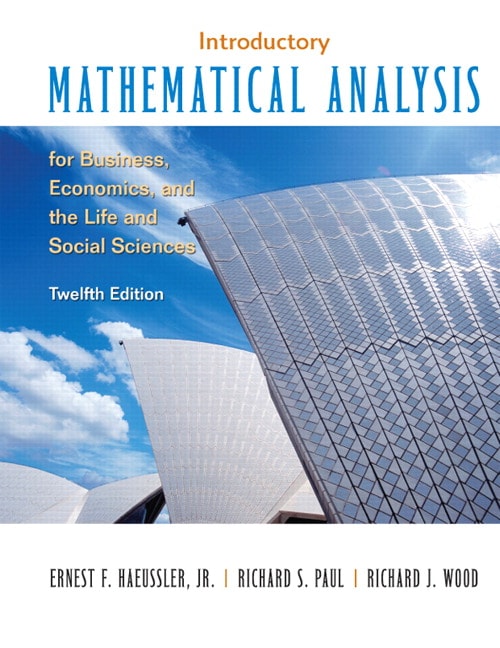
Introductory Mathematical Analysis for Business, Economics and the Life and Social Sciences, 12th Edition

Introductory Mathematical Analysis for Business, Economics and the Life and Social Sciences, 12th Edition

45.00$

Test Banks & Solution Manual

  1. Test Banks for Textbooks. Save money on TEST BANKS
  2. Anticipate the type of the questions that will appear in your exam.
  3. Delivery is INSTANT. You can download the files IMMEDIATELY once payment is done.
  4. Our test banks can help! All test banks are Downloads-take them with you to study!
  5. YOU GET ALL OF THE CHAPTERS. Each Test Bank follows your textbook.
  6. Ace Your Exams with Us! We are Students Helping Students Pass.
  7. Customer Service 24/7

Introductory Mathematical Analysis for Business, Economics and the Life and Social Sciences, 12th Edition Bank Test , Introductory Mathematical Analysis for Business, Economics and the Life and Social Sciences, 12th Edition Textbook , Introductory Mathematical Analysis for Business, Economics and the Life and Social Sciences, 12th Edition PDF , Introductory Mathematical Analysis for Business, Economics and the Life and Social Sciences, 12th Edition eBook , Ernest F. Haeussler, Penn State University Richard S. Paul, Penn State University Richard J. Wood, Penn State University

Category : Higher Education

Table of Contents

Each chapter concludes with a Review and a Mathematical Snapshot.


Chapter 0 Review of Algebra

0.1 Sets of Real Numbers

0.2 Some Properties of Real Numbers

0.3 Exponents and Radicals

0.4 Operations with Algebraic Expressions

0.5 Factoring

0.6 Fractions

0.7 Equations, in Particular Linear Equations

0.8 Quadratic Equations


Chapter 1 Applications and More Algebra

1.1 Applications of Equations

1.2 Linear Inequalities

1.3 Applications of Inequalities

1.4 Absolute Value

1.5 Summation Notation


Chapter 2 Functions and Graphs

2.1 Functions

2.2 Special Functions

2.3 Combinations of Functions

2.4 Inverse Functions

2.5 Graphs in Rectangular Coordinates

2.6 Symmetry

2.7 Translations and Reflections


Chapter 3 Lines, Parabolas, and Systems

3.1 Lines

3.2 Applications and Linear Functions

3.3 Quadratic Functions

3.4 Systems of Linear Equations

3.5 Nonlinear Systems

3.6 Applications of Systems of Equations


Chapter 4 Exponential and Logarithmic Functions

4.1 Exponential Functions

4.2 Logarithmic Functions

4.3 Properties of Logarithms

4.4 Logarithmic and Exponential Equations


Chapter 5 Mathematics of Finance

5.1 Compound Interest

5.2 Present Value

5.3 Interest Compounded Continuously

5.4 Annuities

5.5 Amortization of Loans


Chapter 6 Matrix Algebra

6.1 Matrices

6.2 Matrix Addition and Scalar Multiplication

6.3 Matrix Multiplication

6.4 Solving Systems by Reducing Matrices

6.5 Solving Systems by Reducing Matrices (continued)

6.6 Inverses

6.7 Leontief's Input-Output Analysis


Chapter 7 Linear Programming

7.1 Linear Inequalities in Two Variables

7.2 Linear Programming

7.3 Multiple Optimum Solutions

7.4 The Simplex Method

7.5 Degeneracy, Unbounded Solutions, and Multiple Solutions

7.6 Artificial Variables

7.7 Minimization

7.8 The Dual


Chapter 8 Introduction to Probability and Statistics

8.1 Basic Counting Principle and Permutations

8.2 Combinations and Other Counting Principles

8.3 Sample Spaces and Events

8.4 Probability

8.5 Conditional Probability and Stochastic Processes

8.6 Independent Events

8.7 Bayes' Formula


Chapter 9 Additional Topics in Probability

9.1 Discrete Random Variables and Expected Value

9.2 The Binomial Distribution

9.3 Markov Chains


Chapter 10 Limits and Continuity

10.1 Limits

10.2 Limits (Continued)

10.3 Continuity

10.4 Continuity Applied to Inequalities


Chapter 11 Differentiation

11.1 The Derivative

11.2 Rules for Differentiation

11.3 The Derivative as a Rate of Change

11.4 The Product Rule and the Quotient Rule

11.5 The Chain Rule and the Power Rule


Chapter 12 Additional Differentiation Topics

12.1 Derivatives of Logarithmic Functions

12.2 Derivatives of Exponential Functions

12.3 Elasticity of Demand

12.4 Implicit Differentiation

12.5 Logarithmic Differentiation

12.6 Newton's Method

12.7 Higher Order Derivatives


Chapter 13 Curve Sketching

13.1 Relative Extrema

13.2 Absolute Extrema on a Closed Interval

13.3 Concavity

13.4 The Second-Derivative Test

13.5 Asymptotes

13.6 Applied Maxima and Minima


Chapter 14 Integration

14.1 Differentials

14.2 The Indefinite Integral

14.3 Integration with Initial Conditions

14.4 More Integration Formulas

14.5 Techniques of Integration

14.6 The Definite Integral

14.7 The Fundamental Theorem of Integral Calculus

14.8 Approximate Integration

14.9 Area

14.10 Area Between Curves

14.11 Consumers' and Producers' Surplus


Chapter 15 Methods and Applications of Integration

15.1 Integration by Parts

15.2 Integration by Partial Fractions

15.3 Integration by Tables

15.4 Average Value of a Function

15.5 Differential Equations

15.6 More Applications of Differential Equations

15.7 Improper Integrals


Chapter 16 Continuous Random Variables

16.1 Continuous Random Variables

16.2 The Normal Distribution

16.3 The Normal Approximation to the Binomial Distribution


Chapter 17 Multivariable Calculus

17.1 Functions of Several Variables

17.2 Partial Derivatives

17.3 Applications of Partial Derivatives

17.4 Implicit Partial Differentiation

17.5 Higher-Order Partial Derivatives

17.6 The Chain Rule

17.7 Maxima and Minima for Functions of Two Variables

17.8 Lagrange Multipliers

17.9 Lines of Regression

17.10 Multiple Integrals


Appendix A Compound Interest Tables

Appendix B Table of Selected Integrals

Appendix C Areas Under the Standard Normal Curve


Answers to Odd-Numbered Problems


Index

Instalant Download Introductory Mathematical Analysis for Business, Economics and the Life and Social Sciences, 12th Edition by Ernest F. Haeussler, Penn State University Richard S. Paul, Penn State University Richard J. Wood, Penn State University ZIP OR PDF

What is Test Bank?

The test bank is a guide for testing and exams. It contains a lot of questions with their correct answers related to an academic textbook. Test banks usually contain true/false questions, multiple choice questions, and essay questions. Authors provide those guides to help instructors and teachers create their exams and tests easily and fast. We recommend all students to download the sample attached to each test bank page and review them deeply..

What is Solutions Manual?

The solutions manual is a guide where you can find all the correct answers (odd and even) to your textbooks’ questions, cases, and problems.

Can I get a sample before buying a Test Bank or Solutions Manual?

Samples are attached to each test bank and solutions manual page at our website. We always recommend students and instructors to download the samples before placing orders. At MANUALS1 we offer a complete sample chapter for each product.

Can I download my files immediately after completing the order?

Yes. Our system will grant you an access to download your files immediately after completing the order.

How will I download my product?

You will receive an email from testbanky that contains the download link.

I am not able to download my test bank or solution manual

If you could not download your product for any reason, contact us and we will solve the issue immediately.